Friday, June 14, 2013
Ask a Grammar Ninja
I haven't been very active with this blog. I suppose because I lost motivation. I have a bunch of half-done draft posts I might finish, but things might be much more fun and engaging if some of what I write is motivated purely by people who visit the blog (hopefully there will be such people) rather than just what's in my head at the time. Let's try something different.

Monday, January 9, 2012
The Secrets of Japanese: -てみる (-te miru)
To understand this installment of The Secrets of Japanese, you need to have learned the "te form" of Japanese verbs. I assume that you know how to recognize it, how to form it, and its basic meaning.Sentences marked with an asterisk (*) are incorrect.
My Japanese teacher in high school translated [verb]-てみる as "try to [verb]" and as "try x". However, she also gave example sentences that didn't fit well with attempting to do something, such as the following variations on the theme of eating sushi.
Unless the person in question has some sort of physical or mental problem with eating in general or with eating fish specifically, it does not make sense to say "Would you like to attempt to eat sushi". The context of the conversations in class, the textbook's stories, and our exercises never even hinted at such details. Instead of attributing the strangeness of the interpretation to the idiosyncrasies of a foreign language, it makes much more sense to assume that the interpretation is wrong and that the straightforward translation "do [verb] and see [what it's like]/[what happens]" is correct. In specific cases, such as those of food, or where the point is to experience the thing in question, the meaning of "do[verb] and see" is consistent with "Try [noun]" (as in "You should try ginger" or "You should try hot springs"). When one considers the expression -てみる in this light, it becomes clear that it can never mean "try to [verb]": "do [verb] and see" requires that you finish the action in question, while "try to [verb]" allows for the possibility that you might fail to complete it or even to start.
In the interest of allowing for credit to be given where it might be due, I have to say that I can't recall what my textbook said -てみる means (we were using the Ima! series, level 3, which I think was called Hai, Ima), but I distinctly remember that my whole class was confused. Fortunately for students, there are popularly sold reference books that do not confuse the pattern with "try to [verb]". Unfortunately, those books tend to give a correct definition that is not complete.
Rita L. Lampkin's Japanese Verbs & Essentials of Grammar (pg. 37) gives the "do and see" meaning and the "try doing" one, but not "try [noun]".
Another reference, an nifty book I picked up during my study abroad in Japan titled 「どんなときどう使う日本語表現文型辞曲」(When and How to Use It: A Dictionary of Japanese Expressions and Sentence Patterns),gives "try doing" as the shortcut translation of -てみる and gives the following English description of its meaning: Try something in order to find out more about it (pg. 199). When and How to Use It is written in Japanese with explanations of the expressions in Japanese, Chinese, Korean, and English. It does not provide translations of its examples. The Japanese explanation of the expression translates to "Indicates doing something as a test in order to learn something/find something out."
Although When and How to Use It gives a variety of clear examples, not all of them can be translated according to the "try doing", or "try [verb]ing", pattern. What's going on in the English? Well, we can see from my earlier discussion that "try [noun]" is appropriate whenever the main concern is to experience the noun (to learn what that noun is like). Sometimes, though, the main point of trying something is to test out a certain action or approach as a way to accomplish a particular goal. It seems that that is the major nuance of "try [verb]ing". For instance, if you want to get the taste of some other food out of your mouth so you can appreciate your sushi, someone might tell you to try eating ginger—and though one could respond to the question "what should I use to cleanse my palate?" with "try ginger", one could not tell someone to taste ginger by saying "try eating ginger". Thus, despite the slight overlap in meaning, we can see that the general implications of "try eating ginger" and "try ginger" are different, but they are both consistent with "eat ginger and see"; it just depends on what you see.
Finally, just to play a bit of Devil's advocate, we should ask ourselves how we really know that -てみる means "try [noun]", "try [verb]ing", and "do [verb] and see". After all, if I'm going to question my teacher's interpretation, I should question my own. Furthermore, just because the Japanese expression sometimes matches up with certain uses of the English word try doesn't mean that it actually covers all the same nuances that the English word does. Grammatically, -てみる literally says "[verb] and (then) see", and although the expression lends itself to metaphorical seeing rather than literal seeing, the second examples from Japanese Verbs and When and How to Use It demonstrate that -てみる still retains the much of the meaning of its parts. The food examples I discussed at the beginning of the article and the first example from Japanese Verbs prove that it covers "try [noun]".
The idea that "try [verb]ing" is also covered is supported by Japanese Verbs example number 2 and When and How to Use It example 4. For a definitive example of -てみる in the sense of trying an action as a means to accomplish a goal, I think it'd be fun to consider the "real life" speech of an anime, specifically a scene from the delightfully provocative children's sci-fi show Dennou Coil.The premise of the show is that in the future there are glasses that connect your brain to a physical, three-dimensional virtual reality, which you view and interact with via the special glasses. With the glasses you can type on a keyboard of air, view web pages or email projected on the air in front of you, make phone calls, and even touch virtual pets. Those who do not use the glasses neither see nor are affected by the virtual reality.
In episode 19, the main character's little sister is attacked by a virus that separates her consciousness from her physical body and forces her to wander the virtual world. Left untreated, the girl will fall into a coma. The main character's unusually tech-savvy grandmother has whipped up a hack that will fix the girl's condition, but only if her physical body is within 3 meters of her mind. When the characters are discussing how they can get the girl's mind and body back in the same place, the grandmother says 「可能性は低いが、電話かけてみ」("kanousei wa hikui ga, denwa kakete mi")("The probability [of success] is low, but try calling her"). "Kakete mi", an informal way of giving a command, is equivalent to "kakete mite". The grandmother could not have been saying to try the phone to see what it's like (the characters have all used a telephone before): she can only be saying to test out the possibility of using the phone to reach the girl's mind and tell her where to go to reunite with her body.
Trying Something, or Trying to Do Something?
The difficulty of learning just what [verb]-てみる means is that many Japanese teachers do not fully unsderstand the word try or the difference between the things traditionally labeled the gerund (-ing) and the infinitive (to [verb]). It's clear to native speakers that "Try to do your homework" is completely different from "Try doing your homework", but for many non-native speakers, the difference is not clear since all they see is "try + -ing as a noun" and "try + infinitive as a noun". Similarly, subtleties in other languages' methods of expressing "try" might not be transparent to native English speakers. Since most books define the expression -てみる as try but don't specifically contrast it with "try to [verb]" (or even explain how to say "try to [verb]"), it can be difficult for native English speakers to determine which senses of try the expression covers. Another factor that makes -てみる difficult to interpret is that some books fail to explain its full range of meaning because they treat it as a set phrase to the exclusion of explaining the meaning of its parts. Sometimes -てみる does not mean try, but if the idea that -てみる is mostly analytically transparent (it means what its parts mean ["do something and see"]), not just an idiom for try, is never validated, then students miss or dismiss the idea and learn to use and interpret the expression only for situations that strictly match the English usages of try, whether they're the right senses of the -てみる or not.My Japanese teacher in high school translated [verb]-てみる as "try to [verb]" and as "try x". However, she also gave example sentences that didn't fit well with attempting to do something, such as the following variations on the theme of eating sushi.
| Incorrect Translation | Correct Alternatives |
| 寿司を食べてみて。 sushi wo tabete mite. *"Try to eat sushi" | "Eat sushi and see [what it is like]." "Try eating sushi." "Try sushi." |
| 寿司を食べてみたいですか。 sushi wo tabete mitai desu ka. *"Would you like/Do you want to try to eat sushi." | "Would you like to eat sushi and see [what it is like]?" "Would you like to try eating sushi?" "Would you like to try sushi?" |
Unless the person in question has some sort of physical or mental problem with eating in general or with eating fish specifically, it does not make sense to say "Would you like to attempt to eat sushi". The context of the conversations in class, the textbook's stories, and our exercises never even hinted at such details. Instead of attributing the strangeness of the interpretation to the idiosyncrasies of a foreign language, it makes much more sense to assume that the interpretation is wrong and that the straightforward translation "do [verb] and see [what it's like]/[what happens]" is correct. In specific cases, such as those of food, or where the point is to experience the thing in question, the meaning of "do[verb] and see" is consistent with "Try [noun]" (as in "You should try ginger" or "You should try hot springs"). When one considers the expression -てみる in this light, it becomes clear that it can never mean "try to [verb]": "do [verb] and see" requires that you finish the action in question, while "try to [verb]" allows for the possibility that you might fail to complete it or even to start.
In the interest of allowing for credit to be given where it might be due, I have to say that I can't recall what my textbook said -てみる means (we were using the Ima! series, level 3, which I think was called Hai, Ima), but I distinctly remember that my whole class was confused. Fortunately for students, there are popularly sold reference books that do not confuse the pattern with "try to [verb]". Unfortunately, those books tend to give a correct definition that is not complete.
Rita L. Lampkin's Japanese Verbs & Essentials of Grammar (pg. 37) gives the "do and see" meaning and the "try doing" one, but not "try [noun]".
| From Japanese Verbs |
| おいしいですから、食べてみて下さい。 Oishii desu kara, tabete mite kudasai. "It's delicious, so eat it and see." "It's delicious; try it." (my rendition to illustrate "try [noun]") |
| 怪しい音が聞こえたから、部屋に入ってみました。 Ayashii oto ga kikoetakara, heyani haitte mimashita. "I heard a suspicious noise, so I went into the room to see (check it out)" "I heard a suspicious noise, so I tried going into the room [to see what was up]"(my rendition |
Another reference, an nifty book I picked up during my study abroad in Japan titled 「どんなときどう使う日本語表現文型辞曲」(When and How to Use It: A Dictionary of Japanese Expressions and Sentence Patterns),gives "try doing" as the shortcut translation of -てみる and gives the following English description of its meaning: Try something in order to find out more about it (pg. 199). When and How to Use It is written in Japanese with explanations of the expressions in Japanese, Chinese, Korean, and English. It does not provide translations of its examples. The Japanese explanation of the expression translates to "Indicates doing something as a test in order to learn something/find something out."
| Adapted From When and How to Use It (translations are my own) |
| この新しいボールペンを使ってみました。とても書きやすいです。 Kono atarashii BOURU PEN wo tsukatte mimashita. Totemo kaki-yasui desu. "I tried this new ball-point pen. It's very easy to write with." |
| 日光ですか。ぜひ一度行ってみたいと思っていたんです。 Nikkou desu ka. Zehi ichido itte mitai to omotteita n desu. "Nikkou?(a place) I was thinking I'd certainly like to see it [at least] once." ("...like to go there and see what it's like [to go there]") |
| ちょっとこのスカートをはいてみてもいいですか。 chotto kono SUKAATO wo haite mite mo ii desu ka. "May I try this skirt on for a bit?" |
| コンサートの切符がまだあるか聞いてみましたが、もうないそうです。 KONSAATO no kippu ga mada aru ka kiite mimashita ga mou nai sou desu. "I tried asking whether there were still tickets, but it seems there aren't any any more." |
Although When and How to Use It gives a variety of clear examples, not all of them can be translated according to the "try doing", or "try [verb]ing", pattern. What's going on in the English? Well, we can see from my earlier discussion that "try [noun]" is appropriate whenever the main concern is to experience the noun (to learn what that noun is like). Sometimes, though, the main point of trying something is to test out a certain action or approach as a way to accomplish a particular goal. It seems that that is the major nuance of "try [verb]ing". For instance, if you want to get the taste of some other food out of your mouth so you can appreciate your sushi, someone might tell you to try eating ginger—and though one could respond to the question "what should I use to cleanse my palate?" with "try ginger", one could not tell someone to taste ginger by saying "try eating ginger". Thus, despite the slight overlap in meaning, we can see that the general implications of "try eating ginger" and "try ginger" are different, but they are both consistent with "eat ginger and see"; it just depends on what you see.
Finally, just to play a bit of Devil's advocate, we should ask ourselves how we really know that -てみる means "try [noun]", "try [verb]ing", and "do [verb] and see". After all, if I'm going to question my teacher's interpretation, I should question my own. Furthermore, just because the Japanese expression sometimes matches up with certain uses of the English word try doesn't mean that it actually covers all the same nuances that the English word does. Grammatically, -てみる literally says "[verb] and (then) see", and although the expression lends itself to metaphorical seeing rather than literal seeing, the second examples from Japanese Verbs and When and How to Use It demonstrate that -てみる still retains the much of the meaning of its parts. The food examples I discussed at the beginning of the article and the first example from Japanese Verbs prove that it covers "try [noun]".
 |
| Dennou Coil's main character on her virtual phone. |
| Click here to see a clip of the episode. |
In episode 19, the main character's little sister is attacked by a virus that separates her consciousness from her physical body and forces her to wander the virtual world. Left untreated, the girl will fall into a coma. The main character's unusually tech-savvy grandmother has whipped up a hack that will fix the girl's condition, but only if her physical body is within 3 meters of her mind. When the characters are discussing how they can get the girl's mind and body back in the same place, the grandmother says 「可能性は低いが、電話かけてみ」("kanousei wa hikui ga, denwa kakete mi")("The probability [of success] is low, but try calling her"). "Kakete mi", an informal way of giving a command, is equivalent to "kakete mite". The grandmother could not have been saying to try the phone to see what it's like (the characters have all used a telephone before): she can only be saying to test out the possibility of using the phone to reach the girl's mind and tell her where to go to reunite with her body.
Sunday, January 8, 2012
Why Japanese is Hard to Learn, or The Secrets of Japanese
 |
| This infographic comes from Voxy Blog. |
| Click to enlarge. |
It is not just prestige-seeking braggarts and students making excuses for poor grades that say Japanese is difficult: Even the Foreign Service Institute (FSI) and the National Security Agency (NSA) recognize its difficulty. This declassified paper from the NSA concludes that for English speakers Japanese is relatively harder than Chinese, Korean, Turkish, Arabic, and Vietnamese among others. The FSI has developed a rough categorization of languages (see infographic on the right) according to the approximate study time needed in order for its students to reach its goals. The people at the FSI expect to have to train their students with 2200 hours of class split up into 88 weeks. That's daunting in comparison to Spanish, which is only 600 hours max spread over a maximum of 24 weeks. Let's not forget that those figures do not include the students' study time—it's only the class time! Moreover, the FSI's program is designed with people who are already highly motivated and able to learn language relatively well in a class setting. Since the NSA paper does a thorough job detailing what kinds of factors make learning a foreign language difficult (with especially detailed explanations about Japanese), I'm not going to reinvent the wheel and explain all the features of Japanese that back up these huge numbers; inquiring minds should just check the paper. Instead, I'm going to get straight to my perspective about the problems with Japanese education, why I consider the information hidden, and why I think we can do better than what we have.
When two communities that each speak a different language come into contact, a lot of things can happen—even if you rule out the possibility that one will conquer the other. Sometimes a primitive, mostly grammarless language with words borrowed from the two full-fledged languages develops (In linguistics it's called a pidgin). The Pidgin language can help people get by with daily tasks, such as simple sales and transactions. If children are raised in the pidgin language environment, they might assign more grammar onto the pidgin, expand its vocabulary, and cause it to become a new, separate language (called a Creole). Or perhaps the children grow up to be bilingual. In any case, it's gonna be a while before complicated communication in one language can be understood/interpreted/translated for the other. In the meantime people have to try to decode words and grammar by the situation, make hypotheses about the meanings of the words and the structure of the grammar, and see whether the hypotheses continue to make sense for new situations. Consider how many nuances there are in the word order of English and in vocabulary words such as accountability and responsibility, killing and murder, honest, frank, and blunt. Clearly it's a monumental task. If the two languages are similar (English and Spanish for instance), it's a much easier story—but if the two languages are entirely different in word order and vocabulary (English and Japanese), then it's more complicated. That doesn't even take into account cultural differences in communication. Once some of the members of each community believe they have decoded enough of the other language, they probably start teaching it. Since neither side has a complete picture, there are going to be things that are unclear or even entirely wrong.
One way to teach language in this kind of environment is to teach set translations of difficult expressions and to show students how to use certain grammatical structures in certain situations. Usually this means learning sentence "patterns" that have blanks left in them so that the learner can substitute different nouns or verbs. Then it doesn't matter if no one knows how to use the grammar in any situation: everyone can squeak by for topics they're taught. In this kind of instruction, there's very little emphasis on understanding grammar, whether in the native language or in the other language. Japanese is usually taught this way. For example, many Japanese textbooks do not mention parts of speech and do not label new vocabulary words with possible parts of speech. That can be very confusing if one does not know much about the grammar of the language. If you don't tell English learners that jump can be a verb and a noun, or that some words (such as exploit) have different pronunciations depending on the part of speech, they might not learn how to use or understand those words, even if they have a general idea of what they mean.
Now, this is not to say that that approach to teaching language is all wrong: It can help student's develop fluency by making them familiar with certain ways of saying things and making them repeat similar sentences. Instead of thinking through the grammar to build a sentence for the situation, students can default to certain patterns they know and switch out a few words to adjust to the specific topic and get their point across. However, because they do not know much about the grammar, students will be more likely to make mistakes or be unable to understand "new" uses of the words or structures they learned. They will also have more trouble adjusting to new topics or trying to find ways to express nuances in their native language. A simplistic example of this problem in Japanese education for English speakers is how to say "thank you".
 |
| No matter how much you would enjoy this card, |
| "thank you" cannot change tense. |
Although I can't say for sure, I suspect that Japanese classes typically do not include this information because the material for teaching Japanese-speakers English and the material for teaching English-speakers Japanese are probably old and probably contain the kinds of mistakes that naturally result during the long process of decoding other languages that happens when languages come into contact. Previous generations' hard work at deciphering words, creating dictionaries, and understanding unfamiliar expressions and grammatical structures was not perfect (nor should it have been), and the mistaken/incomplete explanations and solutions have piled up and been transferred through classes to future generations. After all, most Japanese teachers are native speakers of Japanese with an imperfect understanding of English acquired from English-speakers with little to no understanding of Japanese. Similarly, many English teachers in Japan are native speakers of English with an imperfect understanding of Japanese. There are also many English teachers who are native Japanese-speakers with an imperfect knowledge of English acquired from other Japanese-speakers with an imperfect knowledge of English. However, English and Japanese have been in contact for at least 160 years. We should be able to make better grammatical and semantic descriptions now, and we should be able to use the new analysis to revise and demystify the troublesome areas of these languages. Just as this post explained why "thank you" has tense in Japanese, future posts in the series "The Secrets of Japanese" will each tackle a specific difficulty I've run into and discuss the grammatical secret(s) that make each problem easier to understand.
Thursday, December 30, 2010
Police Mascots
 |
 |
| The staging area for commemorative photos, complete with piipo-kun. |
Somehow, though, saying he greeted me at the entrance is putting it lightly: He wasn't just in one place at the entrance—he was all over it.
 |
 |
 |
His name comes from the Japanese pronunciation of the English word people (piipuru, ピープル) and the Japanese pronunciation of the English word police (porisu, ポリス). They mashed the two words together to get piipo because he is supposed to be a bridge between the people and the police. Then they added the Japanese "kun" (a title similar to Mr. or Mrs. except its friendly, not just polite). Someone in the Tokyo metro police station was a fantastic marketer or a refreshingly idealistic person.
 |
| A flyer on the bulletin board outside the Tokyo police headquarters. |
So it seems that Piipo-kun does serve as a bridge between the people and the police. He even has his own website on the Tokyo metro police site. When I got back to my dorm I researched the police mascot thing, and it
turns out that every single prefecture in Japan has its own police mascot. Check them all out here. I'm pretty sure that at public events it's some police officer's job to wear the mascot suit. I find this all fascinating because it seems to be a terrific way for the police to try to maintain a good reputation and be friendly with the citizenry, not that the Japanese police seem to need the help.
Japanese police are remarkably approachable. There is nearly always an officer or two stationed at a police box within a block of each train station. There are even officers who patrol the area on foot in addition to those on motorcycles and in cars. It's an official part of the police's job to give people directions, and the police boxes usually have maps in case the police need extra help telling you how to get where you want to go. The Japanese police even have a supply of money to lend people who have lost their wallets so that they can afford the train ride home (unfortunately not everyone pays the money back).
Now, I'm sure there are corrupt police and cases of police brutality or something in Japan, but most people don't seem worried about such things, and I didn't see any reports of it while I was there (though I also can't read everything in the newspaper yet). These mascots, on top of the direction-giving policy, are PR gold because they ensure that the populace have friendly, non-crime-related interactions with the police force. I wouldn't even dream of stopping the police in America to ask for directions, and I imagine that most people only see the police when they're investigating a crime or handing out traffic tickets. Hopefully, American police still do elementary school visits. Otherwise there's little opportunity for the police to develop a positive relationship with the citizenry. The closest thing to the police mascot America has is McGruff the crime dog, though I haven't seen him around in a while and I don't think he's an official police officer.
I get the feeling, though, that in America people might think extensive use of mascots would somehow be unprofessional. I know at first I thought Piipo-kun was ridiculous. Now, though, I think there's a lot of potential in these sorts of PR techniques to change the paradigm of our relationship with the police. Many communities have a negative view of police, and many don't cooperate with them. But if they never interact with police in a positive way, how can the situation change. It would be nothing short of glorious if the solution to the problem is as simple as a cartoony figure like McGruff, but I don't think it would be unrealistic to say that those kinds of PR moves and positive community interaction could really make a difference.
Tuesday, December 28, 2010
Hello Kitty: Religion and Merchandise
 |
Before I discuss the major instances of Hello Kitty-ness I saw, I'd like to stress that I'm not sure why I started seeing that enigmatic kitten pop up on my travels--it would probably be a foolish ignorance of sample bias to speculate that Hello Kitty is all a tourist trap (I should also note that many of the tourists are Japanese or at least Asian). Since Hello Kitty is something like a cross between a corporate mascot and a logo for Sanrio, a Japanese merchandise company that has been specifically targeting the selling power of cuteness for decades, I suppose I shouldn't be surprised to see her in tourist spots. However, the idea of merchandising doesn't tell the whole story.
Hello Kitty, Itsukushima, and Momiji Manjuu
 |
| The Sanrio shop on Itsukushima |
 |
| A typical momiji manjuu. |
 |  |
 |  |
Hello Kitty, Temples, and Protective Charms
 |
| A bunch of standard o-mamori. |
 |
| Explicitly Hello Kitty protective charms. |
Perhaps the charms are aimed at kids (I can't know for sure since it's an American bias that something cartoony=something for kids; Anyone who saw Ren & Stimpy or looks around on the train in Japan knows otherwise.), and that makes it okay. I know I had a plastic rosary whose craftsmanship was not up to snuff until I could be trusted not to treat a nice one poorly. Maybe I'm looking at the question all wrong. Asian religions such as Buddhism and Shinto (Japan's most popular religions) tend to have far fewer absolute moral strictures (for instance no longstanding insistence that suicide is a sin) than Christianity. Perhaps o-mamori are just tokens that are meant to take bad luck or karma in the place of their bearers, and there aren't strict rules about them. Maybe they just need a blessing from a source of spiritual power and are meant to be enjoyed or appreciated by whoever receives them. If anyone has some insight, let me know. Next time I'm in Japan I'll be sure to ask.
Sunday, December 19, 2010
Temples Temples Everywhere, and Most in Comet Colors
Although I had planned to see a lot of famous temples and shrines in Kyoto, I didn't realize just how many temples there were. As I walked around the city, it was as though they were like Starbucks—one on every corner. I probably should have expected as much; Supposedly more than 90% of Japan is Shinto or Buddhist, but I didn't see that many temples around Tokyo during the semester.
Anyway, here are some shots of the city and some miscellaneous photos. It's almost New Year's (Year of the Rabbit), so there are lots of bunnies.
A river runs through the city from north to south, so there are lots of bridges and walking spots along it. Willow trees, which supposedly have special significance in Kyoto, line the banks. According to a random sign near a group of the trees, when Emperor Saga was looking for a bride hesaw a dream that told him to send a messenger to a willow tree at Rokkakudou (Hexagon Temple). Waiting at the willow was a beautiful woman, whom the Emperor later married.
This temple's name refers to its size (a bay is some old unit of measure), but it's actually famous for its 1001 statues of Kannon, a goddess of mercy. The statues are in a special area where photography isn't allowed, so unfortunately no pictures. Also, I didn't get to see all 1001 statues (no, I didn't count them). A few of them had been rotated out for repairs. It's gotta be tough maintaining a thousand statues.
What I found more surprising, though, was that the rest of the temple was painted in UTD's school colors, orange and green. Although this was not the first temple I had been in, all of the others I had seen during the semester were various shades of brown/wood color, and most TV sshows depicted them as either brown or red. Apparently Japan is so polite and good at customer service that when I called ahead to confirm my reservation at the hostel, they called back a few hundred years and had the standard temple colors changed to be more welcoming for me (Hurray stereotypes!).
To find out the real reason for the color scheme, I had to ask a monk in the information office. Although it was pretty clear that he was dumbing the explanation down a bit in case my Japanese vocabulary was not very good, he basically said that it turns out that part of a traditional grinding process with certain stones resulted in an orange or orangey red color. That color is supposed to be the typical color of Japan's temples. The reason I hadn't seen any orange temples until then was that many of the temples in the area were being restored to that color in recent years. That didn't answer the question about the green, though. When I asked again, the monk simply said that green was thought to go well with orange. I'm not sure whether that means that historians made up the green part after discovering the orange color or whether it means that the temples were actually painted orange and green originally, but I'll take it.
So, to anyone who thinks UTD's colors are weird, I say, Exhibit Kyoto: An entire civilization (at one point the cultural center of Japan) thought it would be aesthetically pleasing to put orange and green together. It can only be culturally offensive to disagree, right?
Here are the rest of my pictures of Sanjuusangendou.
The temple's namesake, Otowa Waterfall is the main attraction. I'm not entirely sure what the waterfall originally looked like, but it appears that it was redirected as a part of the temple. Drinking the water is supposed to give success in school, longevity, and luck with love. In fact, the temple set up a set of metal cups and ultraviolet sterilizers to assist visitors. Some say each of the three streams gives a certain benefit, but others say each one gives all three. I didn't see an official sign with an explanation, so I don't know which one is "right" and I guess which benefit I got is just going to have to be a surprise. I can say, though, that the water is cool and refreshing.
Here's the usual slideshow with the rest of my pictures.
The next stop on my second day in Kyoto was Nanzenji, a huge Zen temple complex. I think it's safe to say that Zen temples are the most fun and most interesting to visit. The entrance to Nanzenji is a giant gate, but unlike most other gates at Japanese temples, visitors can climb the stairs to its top.
You should always be wary of old Japanese stairs though. I can't remember what kind the southern gate of Nanzenji had, but the stairs are typically incredibly short and dangerously steep. We're talking short wooden protrusions from a base frame at 60+ degrees.
Most if not all Zen temples contain gardens, and Nanzenji has its fair share. Japanese gardens tend to be about arranging natural patterns or allowing nature to take shape instead of being about growing food. That's why I like Zen temples so much; they usually have a more interesting view, since they are meant to encourage/facilitate meditation.
Another reason the gardens are made the way they are is to provide a serene backdrop for tea and sitting rooms. One of the temple buildings had one such room available, but I didn't have the time or the yen to stop for tea.
Easily the most unusual thing at Nanazenji was this huge aqueduct. What on earth were the great Roman architectural innovations the arch and the aqueduct doing at a temple in Japan? The structure is clearly incongruous with the other architecture, and I've never seen another one on my travels. Actually, I've never seen the ones in Italy, so until then I'd never seen an aqueduct at all. I don't know the answer to that question, and I was not fortunate enough to spot any temple monks. It's probably from the Meiji restoration, which was, among other things, a movement to modernize Japan that occured in the late 1800s. It looks like it could be from the 1800s at least, not that I'd really know anything about that.
And on that note, here are all my pictures from Nanzenji.
My last stop of the day would be Ginkakuji, but I decided to take the scenic route: From Nanzenji there's a walking path that leads toward the silver temple often called The Philosopher's Path in English, though the name does not totally match the Japanese.
Besides providing a pretty, leisurely walk for residents and tourists (and a romantic walk for couples), the Path is also apparently the favorite hangout of a great many cats. I couldn't help thinking these little philosopher cats had to be what you'd get if Philosoraptor had kids with a bunch of lolcats.

None of the cats appeared to have collars, and according to anime/history, Japanese families tend to put little bells on their pets so they know where they are, so where did they come from? Perhaps they really were sired by Philosoraptor, though it's probably more likely that they're the merchandise at this odd little shop along the way. Either way, I couldn't afford to get stuck in an ontological quandry, since I had to get to Ginkakuji before it closed. Most temples close at 4 or 4:30. Although that seems early, it's usually sunset or near sunset. So all of you who watch anime or have seen Japanese TV, no, they don't stay at school forever, the sun just sets earlier.
The Ginkakuji grounds just reinforced my theory that Zen temples are generally better than all the others. I'm not sure I can do the temple justice with my descriptions, so I'll just leave it to the slideshow. It's hard to see the temple's namesake silver roof and rooster at the top, so watch for it just after the whoosh picture.
Anyway, here are some shots of the city and some miscellaneous photos. It's almost New Year's (Year of the Rabbit), so there are lots of bunnies.
Yanagi: Willow Trees
 |
 |
| Obligatory Engrish. |
Sanjuusangendou: Thirty-three Bay Temple
 |
| Whoosh! |
What I found more surprising, though, was that the rest of the temple was painted in UTD's school colors, orange and green. Although this was not the first temple I had been in, all of the others I had seen during the semester were various shades of brown/wood color, and most TV sshows depicted them as either brown or red. Apparently Japan is so polite and good at customer service that when I called ahead to confirm my reservation at the hostel, they called back a few hundred years and had the standard temple colors changed to be more welcoming for me (Hurray stereotypes!).
To find out the real reason for the color scheme, I had to ask a monk in the information office. Although it was pretty clear that he was dumbing the explanation down a bit in case my Japanese vocabulary was not very good, he basically said that it turns out that part of a traditional grinding process with certain stones resulted in an orange or orangey red color. That color is supposed to be the typical color of Japan's temples. The reason I hadn't seen any orange temples until then was that many of the temples in the area were being restored to that color in recent years. That didn't answer the question about the green, though. When I asked again, the monk simply said that green was thought to go well with orange. I'm not sure whether that means that historians made up the green part after discovering the orange color or whether it means that the temples were actually painted orange and green originally, but I'll take it.
So, to anyone who thinks UTD's colors are weird, I say, Exhibit Kyoto: An entire civilization (at one point the cultural center of Japan) thought it would be aesthetically pleasing to put orange and green together. It can only be culturally offensive to disagree, right?
Here are the rest of my pictures of Sanjuusangendou.
Kiyomizudera: Pure-Water Temple
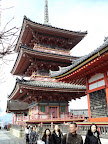
The next stop on my sightseeing list was Kiyomizudera. It's a huge temple complex complete with pagodas, a brilliant view of Kyoto, and a waterfall (sort of). As if to prove the monk from Sanjuusangendou correct, most of the buildings were orange and green.Comet Spirit
 |  |
 |  |  |  |  |  |
Otowa Waterfall
 |
| Ultraviolet Sterilizer |
 |
 |
Love Stones
I'm not sure if it was part of the main grounds or just adjacent to the temple, but I found an interesting scene at the Jishugami (god of the land) shrine. There were two "love stones" (in Japanese koiuranai no ishi or "stones of love fortune-telling"), and it is said that anyone who can start from one stone and reach the other with his eyes closed will have his wish for love granted. The English sign is too Engrishy to be clear, but the Japanese one shows that the whole thing is pretty well planned out. If you can make it in one try, then your wish is fulfilled sooner, but if it takes more than one attempt, then it is granted later. It even accounts for "cheating": If you get help from a friend, then you'll need another's help to make your love reality. When I got there several groups were trying it out. I gave it a shot too, but I failed—the tough part is not the walking straight part but avoiding being run into by all the people who are shopping/sightseeing at the temple and don't realize what you're up to. | Start Stone |
 | Pair of Girls Makes Giggle-filled Attemp |
 | Guy Making the Trip with Help |
 | End Stone |
Here's the usual slideshow with the rest of my pictures.
Nanzenji: Southern Zen Temple
 |
| The Southern Gate |
 |
| View from the top |
Most if not all Zen temples contain gardens, and Nanzenji has its fair share. Japanese gardens tend to be about arranging natural patterns or allowing nature to take shape instead of being about growing food. That's why I like Zen temples so much; they usually have a more interesting view, since they are meant to encourage/facilitate meditation.
 |
 |
 |
 |
| A Sitting Room Overlooking a Garden |
Easily the most unusual thing at Nanazenji was this huge aqueduct. What on earth were the great Roman architectural innovations the arch and the aqueduct doing at a temple in Japan? The structure is clearly incongruous with the other architecture, and I've never seen another one on my travels. Actually, I've never seen the ones in Italy, so until then I'd never seen an aqueduct at all. I don't know the answer to that question, and I was not fortunate enough to spot any temple monks. It's probably from the Meiji restoration, which was, among other things, a movement to modernize Japan that occured in the late 1800s. It looks like it could be from the 1800s at least, not that I'd really know anything about that.
 |
 |
 |
And on that note, here are all my pictures from Nanzenji.
Ginkakuji: Temple of the Silver Pavillion
Tetsugaku no Michi: The Path of Philosophy
 |
 |
| I can has memeburger? |
Besides providing a pretty, leisurely walk for residents and tourists (and a romantic walk for couples), the Path is also apparently the favorite hangout of a great many cats. I couldn't help thinking these little philosopher cats had to be what you'd get if Philosoraptor had kids with a bunch of lolcats.
 |
| "Cat, Fabric, and |
| Accessory Shop" |
None of the cats appeared to have collars, and according to anime/history, Japanese families tend to put little bells on their pets so they know where they are, so where did they come from? Perhaps they really were sired by Philosoraptor, though it's probably more likely that they're the merchandise at this odd little shop along the way. Either way, I couldn't afford to get stuck in an ontological quandry, since I had to get to Ginkakuji before it closed. Most temples close at 4 or 4:30. Although that seems early, it's usually sunset or near sunset. So all of you who watch anime or have seen Japanese TV, no, they don't stay at school forever, the sun just sets earlier.
Ginkakuji
 |
| Sunset—Made it just in time. Whoosh! |
Gion Geisha Hunt
It might have been a bit misleading to say that Ginkakuji was my last stop of the day. After dinner at my hostel (the Kyoto K's hostel [I recommend it]), I ventured back out and headed for Gion, a ritzy entertainment district. I just wanted to check it out, but sometimes you randomly spot some geisha (performers trained in traditional Japanese music and hospitality) travelling between jobs. I had no luck finding geishas, but I did stumble upon a fantastic lantern-lit temple that was open despite the late hour. |
 |  |
| Previous Incarnations of Dean Coleman and Provost | Wildenthal. |
 |
Subscribe to:
Comments
(
Atom
)