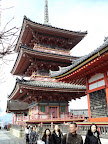
Although I had planned to see a lot of famous temples and shrines in Kyoto, I didn't realize just how many temples there were. As I walked around the city, it was as though they were like Starbucks—one on every corner. I probably should have expected as much; Supposedly more than 90% of Japan is Shinto or Buddhist, but I didn't see that many temples around Tokyo during the semester.
Anyway, here are some shots of the city and some miscellaneous photos. It's almost New Year's (Year of the Rabbit), so there are lots of bunnies.
Yanagi: Willow Trees
A river runs through the city from north to south, so there are lots of bridges and walking spots along it. Willow trees, which supposedly have special significance in Kyoto, line the banks. According to a random sign near a group of the trees, when Emperor Saga was looking for a bride hesaw a dream that told him to send a messenger to a willow tree at Rokkakudou (Hexagon Temple). Waiting at the willow was a beautiful woman, whom the Emperor later married.
 |
| Obligatory Engrish. |
Sanjuusangendou: Thirty-three Bay Temple
 |
| Whoosh! |
This temple's name refers to its size (a bay is some old unit of measure), but it's actually famous for its 1001 statues of Kannon, a goddess of mercy. The statues are in a special area where photography isn't allowed, so unfortunately no pictures. Also, I didn't get to see all 1001 statues (no, I didn't count them). A few of them had been rotated out for repairs. It's gotta be tough maintaining a thousand statues.
What I found more surprising, though, was that the rest of the temple was painted in UTD's school colors, orange and green. Although this was not the first temple I had been in, all of the others I had seen during the semester were various shades of brown/wood color, and most TV sshows depicted them as either brown or red. Apparently Japan is so polite and good at customer service that when I called ahead to confirm my reservation at the hostel, they called back a few hundred years and had the standard temple colors changed to be more welcoming for me (Hurray stereotypes!).
To find out the real reason for the color scheme, I had to ask a monk in the information office. Although it was pretty clear that he was dumbing the explanation down a bit in case my Japanese vocabulary was not very good, he basically said that it turns out that part of a traditional grinding process with certain stones resulted in an orange or orangey red color. That color is supposed to be the typical color of Japan's temples. The reason I hadn't seen any orange temples until then was that many of the temples in the area were being restored to that color in recent years. That didn't answer the question about the green, though. When I asked again, the monk simply said that green was thought to go well with orange. I'm not sure whether that means that historians made up the green part after discovering the orange color or whether it means that the temples were actually painted orange and green originally, but I'll take it.
So, to anyone who thinks UTD's colors are weird, I say, Exhibit Kyoto: An entire civilization (at one point the cultural center of Japan) thought it would be aesthetically pleasing to put orange and green together. It can only be culturally offensive to disagree, right?
Here are the rest of my pictures of Sanjuusangendou.
Kiyomizudera: Pure-Water Temple
The next stop on my sightseeing list was Kiyomizudera. It's a huge temple complex complete with pagodas, a brilliant view of Kyoto, and a waterfall (sort of). As if to prove the monk from Sanjuusangendou correct, most of the buildings were orange and green.
Comet Spirit
Otowa Waterfall
 |
| Ultraviolet Sterilizer |
The temple's namesake, Otowa Waterfall is the main attraction. I'm not entirely sure what the waterfall originally looked like, but it appears that it was redirected as a part of the temple. Drinking the water is supposed to give success in school, longevity, and luck with love. In fact, the temple set up a set of metal cups and ultraviolet sterilizers to assist visitors. Some say each of the three streams gives a certain benefit, but others say each one gives all three. I didn't see an official sign with an explanation, so I don't know which one is "right" and I guess which benefit I got is just going to have to be a surprise. I can say, though, that the water is cool and refreshing.
Love Stones
I'm not sure if it was part of the main grounds or just adjacent to the temple, but I found an interesting scene at the Jishugami (god of the land) shrine. There were two "love stones" (in Japanese
koiuranai no ishi or "stones of love fortune-telling"), and it is said that anyone who can start from one stone and reach the other with his eyes closed will have his wish for love granted. The English sign is too Engrishy to be clear, but the Japanese one shows that the whole thing is pretty well planned out. If you can make it in one try, then your wish is fulfilled sooner, but if it takes more than one attempt, then it is granted later. It even accounts for "cheating": If you get help from a friend, then you'll need another's help to make your love reality. When I got there several groups were trying it out. I gave it a shot too, but I failed—the tough part is not the walking straight part but avoiding being run into by all the people who are shopping/sightseeing at the temple and don't realize what you're up to.
 | Start Stone |
 | Pair of Girls Makes Giggle-filled Attemp |
 | Guy Making the Trip with Help |
 | End Stone |
Here's the usual slideshow with the rest of my pictures.
Nanzenji: Southern Zen Temple
 |
| The Southern Gate |
The next stop on my second day in Kyoto was Nanzenji, a huge Zen temple complex. I think it's safe to say that Zen temples are the most fun and most interesting to visit. The entrance to Nanzenji is a giant gate, but unlike most other gates at Japanese temples, visitors can climb the stairs to its top.
 |
| View from the top |
You should always be wary of old Japanese stairs though. I can't remember what kind the southern gate of Nanzenji had, but the stairs are typically incredibly short and dangerously steep. We're talking short wooden protrusions from a base frame at 60+ degrees.
Most if not all Zen temples contain gardens, and Nanzenji has its fair share. Japanese gardens tend to be about arranging natural patterns or allowing nature to take shape instead of being about growing food. That's why I like Zen temples so much; they usually have a more interesting view, since they are meant to encourage/facilitate meditation.
Another reason the gardens are made the way they are is to provide a serene backdrop for tea and sitting rooms. One of the temple buildings had one such room available, but I didn't have the time or the yen to stop for tea.
 |
| A Sitting Room Overlooking a Garden |
Easily the most unusual thing at Nanazenji was this huge aqueduct. What on earth were the great Roman architectural innovations the arch and the aqueduct doing at a temple in Japan? The structure is clearly incongruous with the other architecture, and I've never seen another one on my travels. Actually, I've never seen the ones in Italy, so until then I'd never seen an aqueduct at all. I don't know the answer to that question, and I was not fortunate enough to spot any temple monks. It's probably from the Meiji restoration, which was, among other things, a movement to modernize Japan that occured in the late 1800s. It looks like it could be from the 1800s at least, not that I'd really know anything about that.
And on that note, here are all my pictures from Nanzenji.
Ginkakuji: Temple of the Silver Pavillion
Tetsugaku no Michi: The Path of Philosophy
 |
 |
| I can has memeburger? |
My last stop of the day would be Ginkakuji, but I decided to take the scenic route: From Nanzenji there's a walking path that leads toward the silver temple often called The Philosopher's Path in English, though the name does not totally match the Japanese.
Besides providing a pretty, leisurely walk for residents and tourists (and a romantic walk for couples), the Path is also apparently the favorite hangout of a great many cats. I couldn't help thinking these little philosopher cats had to be what you'd get if Philosoraptor had kids with a bunch of lolcats.

 |
| "Cat, Fabric, and |
| Accessory Shop" |
None of the cats appeared to have collars, and according to anime/history, Japanese families tend to put little bells on their pets so they know where they are, so where did they come from? Perhaps they really were sired by Philosoraptor, though it's probably more likely that they're the merchandise at this odd little shop along the way. Either way, I couldn't afford to get stuck in an ontological quandry, since I had to get to Ginkakuji before it closed. Most temples close at 4 or 4:30. Although that seems early, it's usually sunset or near sunset. So all of you who watch anime or have seen Japanese TV, no, they don't stay at school forever, the sun just sets earlier.
Ginkakuji
 |
| Sunset—Made it just in time. Whoosh! |
The Ginkakuji grounds just reinforced my theory that Zen temples are generally better than all the others. I'm not sure I can do the temple justice with my descriptions, so I'll just leave it to the slideshow. It's hard to see the temple's namesake silver roof and rooster at the top, so watch for it just after the whoosh picture.
Gion Geisha Hunt
It might have been a bit misleading to say that Ginkakuji was my last stop of the day. After dinner at my hostel (the Kyoto K's hostel [I recommend it]), I ventured back out and headed for Gion, a ritzy entertainment district. I just wanted to check it out, but sometimes you randomly spot some geisha (performers trained in traditional Japanese music and hospitality) travelling between jobs. I had no luck finding geishas, but I did stumble upon a fantastic lantern-lit temple that was open despite the late hour.
 |  |
| Previous Incarnations of Dean Coleman and Provost | Wildenthal. |